Monday, December 17, 2012

hummingbird feather
hummingbird feather

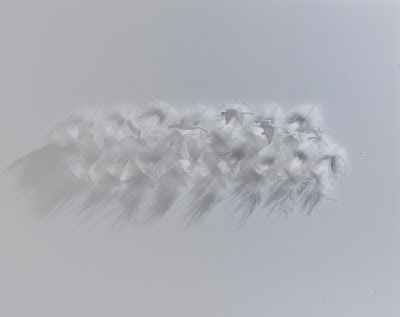
On Sunday I participated in the Audubon Society’s annualWinter Bird Count.  Each participating city has a five- mile radius circle where people divide up and count as many kinds of birds as they can. Being almost the darkest day of the year, at least in the northern hemisphere, it was cold, windy, and rainy.  I thought the birds would, like me, want to get to a warm cozy place. But then I looked closely and saw that their feathers were sheltering them. The curved body feathers were fluffed up. They were shedding the rain, and keeping the wind out. So elegant and cozy. When I went home, I took off my cumbersome and relatively ineffective clothes--my outdoor feathers. I sat under the roof inside my house by a warm fire--my indoor feathers. 

Sunday, December 2, 2012

For December, my work will be at Zeitgeist and Row House in Seattle. 

Row House is a cafe/restaurant on Republican by the Amazon Headquarters offices. It is a nice and funky atmosphere and despite the low lighting in places, my work displays nicely there.  We hung 25 pieces December first.  They will be on display until at least the middle of January.  A reception is planned for early January--more about this later once the date is nailed down.

Zeitgeist is in the gallery district downtown Seattle in Pioneer Square on Jackson Street.  The artist reception at 6: pm on December 6th coincides with the first Thursday Seattle Arts Walk.  Work will be hung December 5th, up to 20 pieces.  This show will go until January 2nd.

Sunday, November 18, 2012

What was any art but an effort to make a sheath, a mould in which to imprison for a moment the shining, elusive element which is life itself -- life hurrying past us and running away, too strong to stop, too sweet to lose? --Willa Cather from Song of the Lark (1915).

This was read to us this September by Robert Bateman after the Birds in Art museum show in Wisconsin.

..."the shining, elusive element which is life itself..."  Cather says it best.  It is often what I want to capture in my work.

Sunday, November 11, 2012


I prefer to use molted feathers that a bird sheds.  It’s kind of like recycling.  Nevertheless, sometimes people give me their pet bird that died.  Often, an owner who treasured their bird wants to see the feathers put to use when the bird dies – as sort of an  honor the bird. So I have learned to pluck and do a bit of taxidermy-type work.  It was distasteful at first, but now I see it as just part of life.  So here are the wings of four parakeets.  They curve in a beautiful angelic way, smaller than the palm of my hand.   

Monday, October 22, 2012

Painting on feathers


I strive in my art to honor feathers and the birds they came from.  Some talented people paint on them but it is not something I am drawn to do. That said, I came across a man’s work that impressed me.  Super Regalia.  He paints mostly to imitate feathers that are otherwise illegal to have—like hawks and eagles; or painted to look like rare and hard to find feathers like the tails of Red-tail Black Cockatoos.  These feathers caught my eye because it is hard to tell them apart from the real thing. He sells them and uses them in Native regalia—fans, bustles, and such.  

Monday, October 8, 2012

Feath, Feather, Feathest


I saw a cartoon in the New Yorker with three different pictures of Jupiter with a caption under each, “Jupit”, “Jupiter”, “Jupitest”.  Which got me to thinking about a piece entitled “Feath, Feather, Feathest”.   Once in a while an aviary bird dies in mid-molt, when its feathers are still growing and the owner gives me the dead bird.  This just happened with a Scarlet Macaw.  Its full grown feather would have been 20 inches or so long.  But this partly grown feath is just 7 inches.  When I take a full grown tail and cut some flying macaws out, it will become feathest.

Friday, September 28, 2012

Olympia Fall Arts Walk
October fifth, 5:- 10:pm  October sixth, 12 noon to 5:pm

chris maynard, feather art - peacockYoga Loft is a large, beautifully sparse space.  I am excited to show about feather shadowboxes there, more than I have ever hung at once. They go up Sunday night, October 1st.  Prints of my work will also be available for purchase.  See you there!

219 Legion Way--Near Capital Lake


Monday, September 10, 2012


The Birds in Art show in Wausau Wisconsin was spectacular, go if you can.  That town treats artists well and attracts talented and devoted artists who paint, sculpt, and in other ways visually honor birds. As you might imagine, people were interested in my work because they had never seen feathers used in the way I do.  I in turn, met many excellent artists and have new ideas for pieces that I can’t wait to begin. Robert Bateman is a Canadian artist who paints the natural world. He is starting an environmental education center in Victoria B.C. with a gallery that I hope to exhibit in one day—if I can successfully negotiate the legalities of importing and exporting the feathers contained in my works. 

Monday, August 27, 2012


I just returned from a week long artist business boot-camp in Port Townsend.  The program is called ‘EDGE Professional Development’ sponsored by Washington Artist’s Trust.  Fifteen of us were selected from around the state but only three of us were men.  I felt right at home having been far outnumbered by a lot of sisters. One benefit of this boot camp is to have the opportunity to collaborate on joint shows with some of these artists as well as work together creating artworks with feathers and other mediums.  For instance, Kara McGhee paints realistic birds sometimes using interesting lighting effects so a joint show makes sense.  Laurie Fronek 'draws' in 3-d wire sculpture and there may be an opportunity to collaborate on a 'wire-feather' piece.

Artist Trust offers support to artists in many ways: grants, professional development, opportunities like shows, connection with other artists, and fellowships and grants.  And not just visual artists like me but writers and performing artists.

Sunday, August 12, 2012

Swallows in Flight #1


I love watching the barn swallows fly and will be sad when they leave in September.  I made this piece in their honor.  They make their home in my barn and I get to watch their young grow up although a local Merlin falcon has been having its way with a few.  The feathers in this piece are from the wing of a Lilac Breasted Roller.

The strikingly colored Lilac Breasted Rollers live in Sub-Sahara Africa.  Their form is close to barn swallows in silhouette—with the forked tail.   I started out drawing silhouettes of the Lilac Breasted Rollers in flight but ended up with swallow shapes since I am closer to these birds.  In the piece, I wanted to highlight the blues of the sky from where the swallows swoop, eat, socialize, catch airborne feathers for their nests, mate, drink from my sprinkler, and frolic.   The small size of the feathers and hence the cutouts was a challenge.

Monday, July 30, 2012

Birds in Art


A piece of mine was accepted in the 2012 Birds in Art show, put on by the Leigh Yawley Woodson Art Museum in Wisconsin.  Each year they put out a nice full color catalog with accepted artists’ works from all over the world.  An Olympia artist, Judy Smith gave me several of the previous year’s catalogs  where I gleaned several ideas for new pieces, one of which I pursued.  One piece that gave me the idea for a new piece was a sculpture by John Richen titled Symphonic Flight. It is bronze and stainless steel and sort of looks like two feathers but one looks more like a bird in flight with some wind added.  It set me to thinking.  Just the shape of a flight feather suggests movement.  Since I strive to honor the qualities of the feathers I work with, I used a pair of matching flight feathers set as dual images and kept one uncut, whole.  The other I subtracted bits and pieces and ended up with the feathers shape but with a lot of connected bird shapes in flight. This may be the beginning of a series.  

Monday, July 16, 2012

Many Eagle Feathers


eagle flight feathers

In just one mile on a remote Washington beach laid all these and more eagle feathers.  They were sitting on the sand and mixed in the drift at the high tide mark.  After being arranged in a circle, the tide redistributed them up and down the beach where they now lie.

Curiously, almost all of these feathers were from the tips of the wings, the primaries.  These birds more or less shed only two matching feathers at a time, one from each side.  Most small birds start their molt in the middle of the wing and proceed outward over a few months until growth is complete.  Larger birds like the eagle may take several years since it is harder for them to fly with even one feather shed from each wing.  I wonder where all these feathers came from since I only saw about half a dozen eagles all day.

Sunday, July 1, 2012

Warm Feathers


Growing Goose Feathers are warm

My geese are molting their feathers.  Unlike most birds, geese and other kinds of waterfowl shed their feathers all at once.  So now, the goose feathers are strewn all around my field. Sometimes my geese get out which is where they were when I got home this afternoon. As I herded them back into the field, I caught one to see how its feathers were growing back in.  When I grabbed the bird, it felt warm as they always do since their temperature is 6 or 7 degrees warmer than ours.  What surprised me was that the growing feathers were just as warm.  

I had never felt warm feathers.  But it isn’t really so surprising when you know that the growing feathers are heavily supplied by blood.  So much that if I cut the bigger goose feathers off at the shaft, the bird could bleed to death.  So this is a time of their lives that try to treat themselves more gently until the feathers are fully grown.  

Monday, June 18, 2012

Feathers for the Swallows


dead swallow and goose feather
Violet-green swallow on a big feather that he may have carried up to feather his nest if he hadn't crashed into a window.

A huge bag of goose feathers stands by my front door for the swallows.  They use them to line their nests.  When the swallows arrive in spring migration, they begin to build the nests and are on the lookout for materials.  In May and June, if it isn’t raining, I grab a handful of goose feathers from the bag every time I go outside.  Feathers scattered on the ground attracts barn, violet green, and tree swallows.  But they prefer to catch floating airborne feathers rather than swooping down face-first to grab them off the earth.  So I blow feathers from a ten-foot plastic pipe into the air for the birds to snap up.  The birds soon learn what I am up to when I pick up the pipe: they fly around and around, waiting for a feather to come out.  I notice that from the beginning to the end of the season, their feather catching skills improve.  They learn to grab them by the fluff at the front of the shaft and fly with them curved underneath their bodies.  So I give them bigger and bigger feathers, even larger than the ridiculously large size of the feather pictured under this poor bird that crashed into a friend’s window.    

Monday, June 4, 2012

Why Feathers Are Curved Part 2


Flight.  

argus pheasant feathers
Great Argus Pheasant wing tip feathers
A mix of side-to-side and front to back curve feather curve lets each kind of bird fly in their own special way. 

How a feather shaft is shaped depends on what type of flight is important:
 
·         quick but short bursts of flight like seen in pheasants and a lot of songbirds. The first primary flight feathers of these birds are super-curved from side to side but not so much front to back.  This makes for a quick lift-off.  Think of a forest grouse that explodes off the ground, usually scaring the bejeezus out of anyone close by. 
·         soaring flight like vultures and eagles. The main flight feathers have some front to back curve or camber.  My sister showed me a huge Wood Stork primary feather from Tanzania that had so much front to back arc camber that five of them would make a full circle. 
·         Fast flyers like swallows, ducks, and falcons or gliders like seagulls.  Their feathers usually have less curve both side to side and front to back. 

Other aspects of wing flight feathers like their shapes let them do what they do in flight.  Which is a good subject for an upcoming series of blog articles: shapes of feathers.
  
There is way more to flight feather curves than what I have outlined here.  A good source to start with is the 2010 book, Bird Feathers: AGuide to North American Species by David Scott. 

Sunday, May 20, 2012

Why Feathers are Curved. Part one.


floating goose body feather

Why the shaft of feathers are curved. Part one. 

Most feathers have some curve to their shafts.  One of the reasons is for warmth.  A front to back bend on a body feather serves to control a bird's temperature. 

Feather curves are the main reason I use shadowboxes rather than trying to make the feathers lie flat.  I want to honor their natural shapes.

The most consistently and intensely curved feathers I know of are the body feathers from waterfowl.  Many of the body feathers on a swan are so inwardly curved that it takes only two to make a complete circle.  On most birds, the curve allows a larger air space between the body and the elements.  It’s like the wider the insulation is in your house or the thicker the layers of your clothing is, the warmer you are.  A neat thing about birds though is they can control how thick the air layer is.  Through muscle-feather control they can flatten the flexible shafts, pushing them next to their body.  Or they can fluff themselves by letting their feathers naturally curl to their max like you see songbirds do on a cold winter day.  I wish I could do that with my clothes.

Sunday, May 6, 2012

Swans and their Feathers


Mute Swan Feather Assemblage Cutouts Art
Swan Feather cutouts  --mute swan
Someone actually counted every feather on a swan and came to the conclusion that they have more feathers than any other bird on earth.  I’m not sure that is true although it is the generally accepted or at least most widely quoted figure:  24,000.  Take the numerous outer feathers away on a bird like this and you have essentially a  long underwear-like layer of soft down feathers.

Everyone knows a swan is all white.  The all-white swan is beautiful and often triggers notions of the meaning of white, like purity and angels.  But white feathers are weaker and less durable than black ones.  Why? It has to do with the protein melanin, the same stuff that makes light-skinned people tan and gives some people freckles.  Melanin in feathers strengthens them against wear and also makes them black or reddish brown.  Many large birds need their primary flight feathers to last a long time.  A lot of mostly-white birds have black feathers where they need the strength and durability—in the flight feathers. White pelicans, snow geese,, white stork, wood stork, and many seagulls are mostly white except for their primary flight feathers.   

So then why is the Black Swan from Australia is all black except the tips of the wings white?  I don’t know for sure but assume that it’s because swans just keep their wings folded in when they feed, so except for flying, they don’t have to worry as much as other birds about wear and tear on their wing feathers.

I have been working a little with Martha Jordan of the Trumpeter Swan Society whose work includes rehabilitating, protecting, and reintroducing Tundra Swans.  


Sunday, April 22, 2012


Chinese Ring-Neck, Mikado, Copper, Elliots, Reeves

55 Kinds of Pheasants and their feathers

The world has fifty five species of pheasants, almost all from Asia.  One of the great things about these large birds is that the male of each species grows at least four different interesting types of feathers.   And half of the males and females grow totally differently colored and patterned feathers.  Let me see, that’s over 300 interesting different kinds of feathers to work with! 

Here are two more reasons why feathers from these birds are great.  First, the males use feather size, pattern, form, shape, and color to attract their mates.  Second, pheasants are large, so their feathers are big and showy.  Here are a few:

·         Long-tail pheasants have long tails – like the ringneck pheasants people hunt and also pure black and white stripes tails from Mikados that live only in Taiwan, and a Copper that live only in Japan.
·         Peacock pheasants are perhaps an ancestor of the peacock but a lot smaller and with  bright round eyes on their tails
·         Tragopans have little round spots all over, some are a bright red with round white spots and one is black with round white spots.
·         Junglefowl are the ancestors of chickens
·         Three species of peacocks, the Java Green, the India, and the Congo which looks a lot different and is the only pheasant originating outside Asia.  It is from Africa.

I had a male Impeyan Pheasant, a stocky species that lives high in the Himalayas.  It escaped my cage one day and flew into a neighbor’s grass hay field 1/3 mile away.  A normally colored bird would disappear, blending in with the deep grass and I never would have found it.  But the Impeyan’s brilliant metallic feathers showed like a beacon.  I imagine that this bird’s metallic and reflective feathers led to the demise of many of its kind.  So its advantages of attracting mates must outweigh this major disadvantage. 

Monday, April 9, 2012

The Most Beautiful Bird on Earth


Number patterns 0-9 found on Argus Pheasant feathers
It’s not the color; it’s the patterns on the feathers that make this peacock-sized bird so awesome.   How can a bird that grows only black, white and brown feathers be so attractive?  It’s because the patterns vary so much.  The bird sports eyes on some of its wing feathers that look exactly like the eye spots on some moths.  And there’s not only one or two eyes on each feather but 10 or more!  At 30 inches long, these impress me as the most wondrous feathers on earth.  The female wing feathers show reticulated markings like Arabic writing.  The male’s five-foot black and white spotted tail feathers, of which the bird grows only two, twist curiously into spirals at the tips.  Even the feathers under the tail differ in unique patterns and sizes.  The longest 13-inch top ones grow downy filaments half-way up the shaft and then turn into yellow-brown top feather with large black spots.  Then under the tail and with the same markings as the tail, are feathers that look like Ping-Pong paddles cut in half but grow up to 18 inches long. 

When I was in my early 20s, I worked on a family friend’s grape vineyard during Spring Breaks.  They kept a few large  Argus wing feathers displayed in a jar on their counter.  I think I can trace an increase in my obsession with feathers back to those.  Now, a good portion of my work with feathers is with the Great Argus Pheasant.  I’ve made an alphabet just from the patterns in the different feathers of the Argus pheasant.  Actually, there were so many patterns I discovered, that I had to decide between at least three choices of each letter for which one to include in the alphabet poster.  Here is a two-minute Argus Pheasant video (on ARKive) so you can get to know the bird

OK, I admit, peacocks are equally beautiful in a different way.  But they much more common and therefore can sometimes seem a bit, well, too common for use in artwork, though I do and I love them.